What if we've been teaching children backwards?
Most homeschool programs focus on what children should learn. ICONIX begins with how they learn. When children recognise patterns, build concepts, and trust what they observe, reading, maths, science and history all get easier — not because the subjects changed, but because the learner did.
We build the learner before we build the lesson.
Conventional instruction starts at the top — deliver the content and hope it lands. ICONIX builds from the bottom: first the capacity to learn, then the skill, and only then the content, which finally has somewhere to live. When a child struggles, the problem is almost never the subject.
Capacity → Skill → Content
It is progressive overload for the nervous system: growth happens at the edge of comfortable, not past it. Build the capacity and the skill follows; force the content first and you get a child who can perform it on Friday and has lost it by Monday.
Start here: which reader is at your table?
Reading is where this shows up first and clearest, so it is where we start. Every child reading — or fighting — a book tonight is one of these three, and the difference between them was never effort. It is whether imagery is leading.

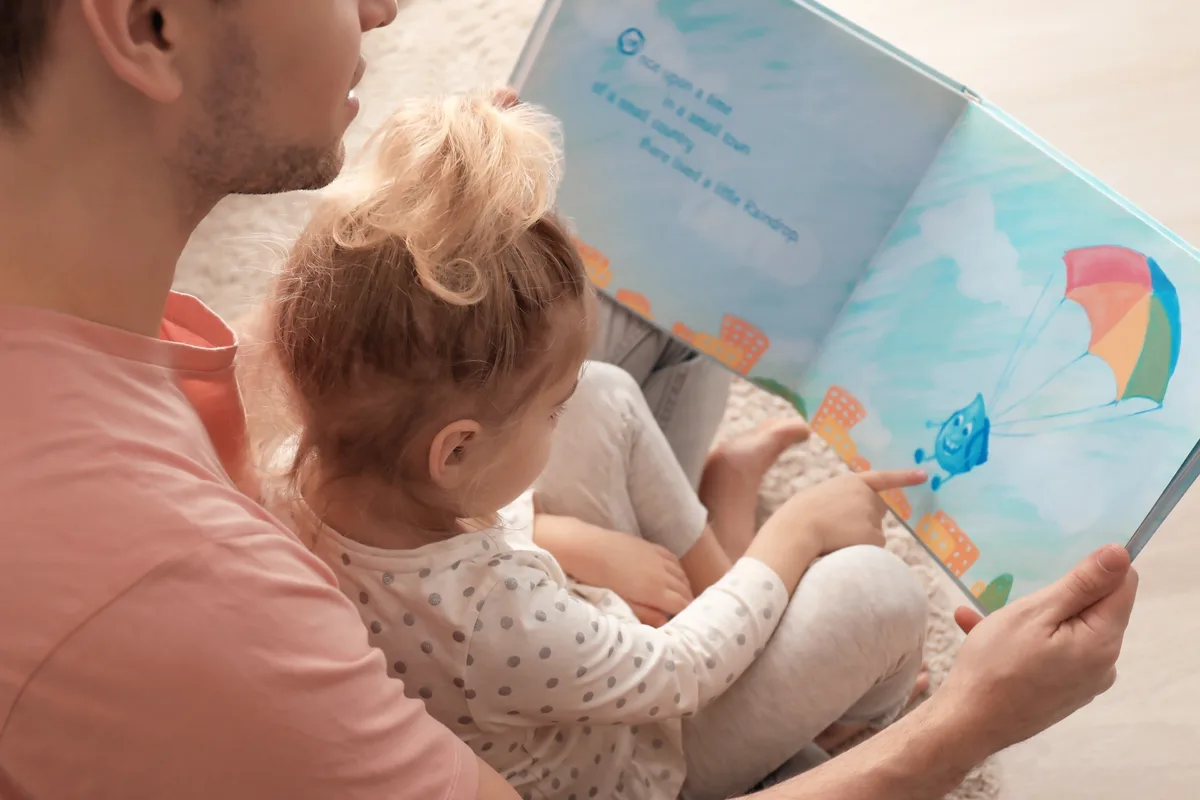
Sees the story
The words disappear and a picture takes over. Ask what they read and you get a world, not a sentence. This reader devours books — this is what reading is supposed to feel like.
Hears the story
An inner narrator reads every word out loud, one at a time. It works — but it’s slow and tiring. This reader needs silence, and a chapter costs real effort.

Fights the words
Every word must be worked out before it means anything, and there’s nothing left over for the story. Ask this child why reading is hard and you’ll get one word: “words.”
The third one is not a verdict on your child. It is a missing step — and steps can be built.
The usual road into reading
- Start with the symbols on the page
- Decode first, understand afterwards
- Struggling? Drill the same layer harder
- Reading is the skill being taught
The ICONIX road
- Start with the picture in the mind
- Understand first, the symbols follow
- Struggling? Find the step underneath and build it
- Seeing is the skill — reading comes with it
First learn to see. Then see to learn.
Nine tenths of a Spatial Reading session happens with the book shut — and that is not a delay, it is the method. You are not teaching reading. You are teaching seeing: the mental imagery, the eye control and the prediction that fluent reading actually stands on. ICONIX goes Word → Image → Meaning: the picture first, the symbols after.
Reading stands on four pillars, and letters are not one.
Every one of these sits underneath the page itself. Each is developmental and buildable, and each can be measured — so you never spend months working on the wrong thing.
1 · Motor function
Steady, controlled eye movement — the last motor milestone. A child who loses their place, skips lines, or tires in minutes usually has an eye-control gap, not a reading problem.
2 · Instant visual recognition
Object → picture → symbol, each recognized instantly. If symbols aren't automatic yet, the child substitutes the only tool they have: sounding out.
3 · Creation of imagery
The movie in the mind. This is what reading is for — and for some children, nobody ever told them a picture was supposed to come.
4 · Predictive capacity
"The farmer milked the ____." You didn't decode that missing word — you predicted it. The fluent reader is always slightly ahead of the page.
We measure before we teach
ICONIX specialists assess exactly where your child sits in each pillar. That's a measurement, not an opinion — and it will save you months of working on the wrong thing.
Twelve keywords. One clock face. A whole subject.
Every ICONIX lesson circles an Iconic Concept Map: twelve keywords turned into icons a child can see, say, sign, and walk to. Underneath runs the VAMA cycle — Visualize, Associate, Manipulate, Apply — so a student never just hears an idea, but sees it, connects it, works it, and uses it. The wheel below is the first one every family meets — Era 0: the Historian's Craft, twelve ways of asking how we know anything at all.
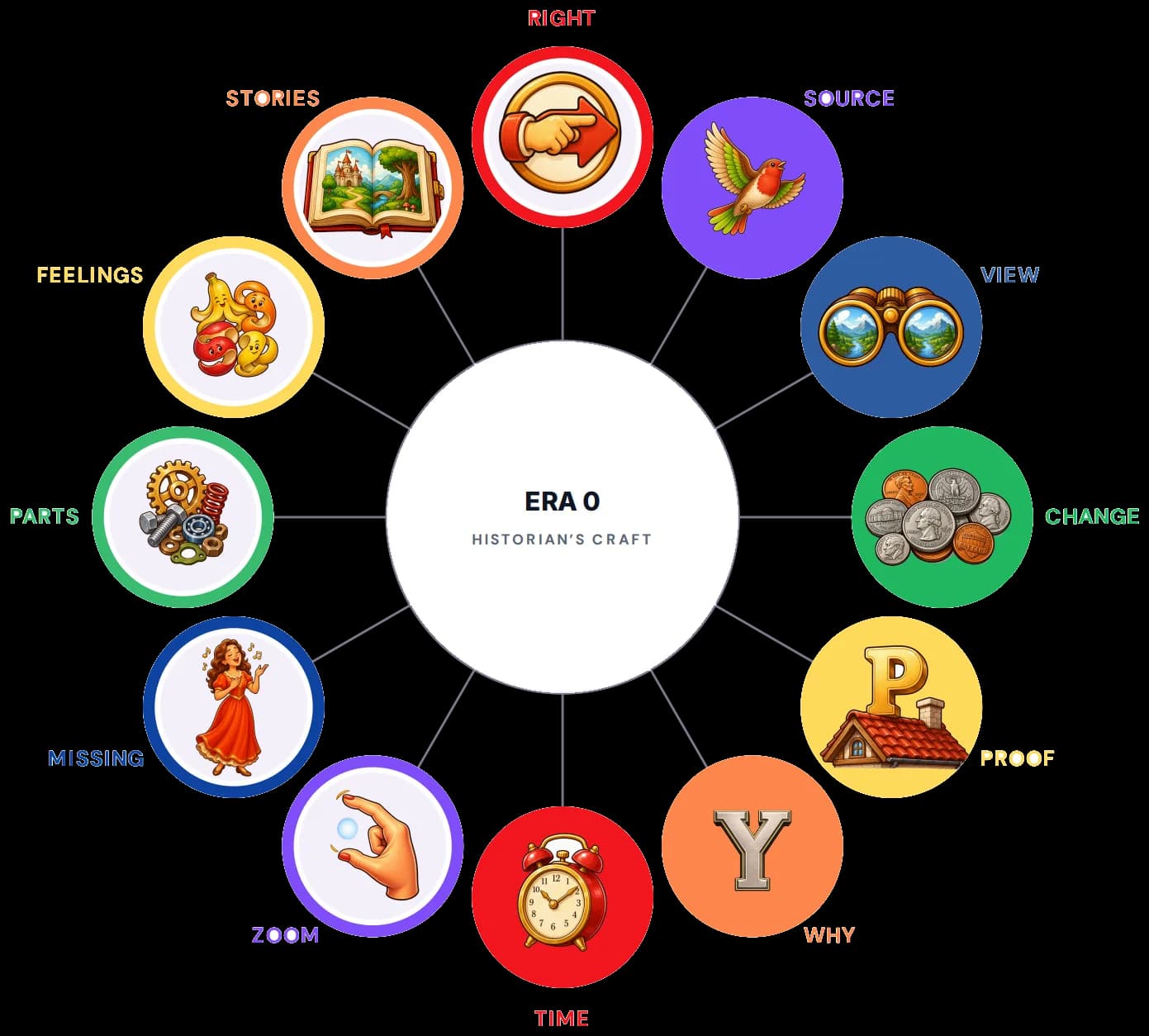
The same twelve spots carry a first-grader's "source" and a teenager's "provenance." A six-year-old and a graduate student, working on the very same word — that is exactly the point.
One engine. Four doors in.
Reading, writing, pre-reading, and spelling are one system sharing one circle, one color code, and one rule: the picture comes first.
Spatial Reading
The reading method: twelve steps on the floor, and the book doesn't open until step ten. Imagery is proven first, anchored spatially, loaded for speed — then the text confirms what the mind already sees. "Reading was never the words. It was always the picture."
VisuFlect Junior · pre-readers
"One picture. Twelve spots. A whole sentence. And not a letter in sight." Children who can't read yet build real sentence structure with their feet — walking, talking, and stepping. If they can name a thing and take a step, they can start.
VisuFlect · writing
"One photo. One concept. One sentence at a time." Sixteen weeks, fifteen minutes a session, and you never need to know grammar to run it — the photo is the proof, the writing is just the translation. A child's sentence is never rejected; it is only ever added to:
Visual Spelling
"Spelling isn't about how a word sounds. It's about how it looks." The flash game trains true eidetic memory — flash the word, ask the letters out of order, then the magic step: spell it backwards. The only way to do that is to see it in your mind.
"What was the fourth letter?" … "Now spell it backwards."
Stop memorizing. Start seeing — and watch the 100s start coming home.
Beyond reading: the whole curriculum, one wheel
Twelve subjects framed by the four anchors, on a compounding schedule: each week one new concept plus the previous three, revisited as games. Repetition that feels natural, not boring — less forgetting, more mastery.

Two ways to teach a child
One of these paths produces test-passers. The other produces thinkers who keep the knowledge for life.
Mastery, not grade levels
We don't teach based on arbitrary grades. Progress is measured by mastery, not age — no artificial ceilings for kids who race ahead, no shame for kids who need another pass, and one program for every child in your house.
Open hands, open door
ICONIX grew from Christian roots, and we hold that faith with open hands — teaching the world with awe and wonder, never with a gate. Bible is an enrichment option families choose; every family, of every belief, is warmly welcome here. Our story →
Not ready to decide? Start with the booklet.
Our free booklet explains the method itself — the diagrams, and a plain account of how children learn a concept instead of memorising it. It is the thinking underneath everything we teach, written for a parent, not a teacher. One short read, no sales pitch.
No spam, no pressure — just the booklet and an occasional hello.
See a session with your own eyes
Create a free account and meet the pods and the people who lead them — no card, no commitment.
Start building a better learnerFree to browse · one account covers your whole family · questions? Text 231-360-0751